
Predicting deformation in induction shrink fitting: A tool holder case study
Induction shrink fitting relies on rapid, localized thermal expansion to achieve very tight interference fits for high-precision tooling. In tool holder assemblies, achieving the necessary radial clearance to insert or extract a cutting tool requires precise electromagnetic power delivery.
However, induction heating creates steep, non-uniform thermal gradients. If local thermal stresses exceed the temperature-dependent yield strength of the material during heating or cooling, the component undergoes irreversible plastic deformation. This permanently alters bore geometry, degrades gripping torque, and compromises runout precision.
By integrating mechanical stress and strain dynamics directly into the electromagnetic-thermal simulation loop, engineers can evaluate structural integrity alongside thermal expansion before physical testing.
The Challenge of Precision Shrink Fitting
To deliver sub-micron concentricity and high gripping torque during high-speed CNC machining, shrink-fit tool holders rely on a precise interference fit. Every time a tool is installed or replaced, the holder must undergo a rapid thermal cycle: heating up to expand the bore for tool insertion, and cooling down to lock the tool in place.
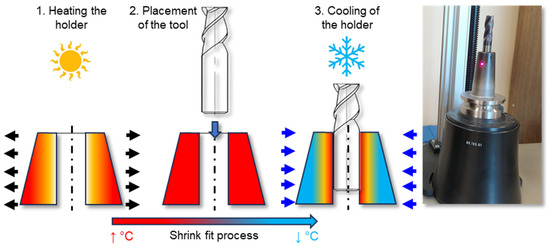
Induction heating is the industry standard for this process due to its speed and repeatability. However, the process carries a hidden mechanical risk. Because of the electromagnetic skin effect, induction energy concentrates in a shallow outer layer of the holder wall. This generates an extreme, localized temperature gradient – the outer surface expands rapidly while the cooler, inner core temporarily resists expansion.
When this rapid thermal expansion is constrained by adjacent colder metal, localized Von Mises stress spikes. At elevated temperatures, the yield strength of tool steels drops significantly. If the thermal stress exceeds this reduced yield limit, the material undergoes irreversible plastic deformation.
Over repeated tool changes – or even a single severe overheating event – this accumulated plastic strain causes permanent bore distortion and loss of clamping force.
Case Study: H13 Tool Holder Simulation
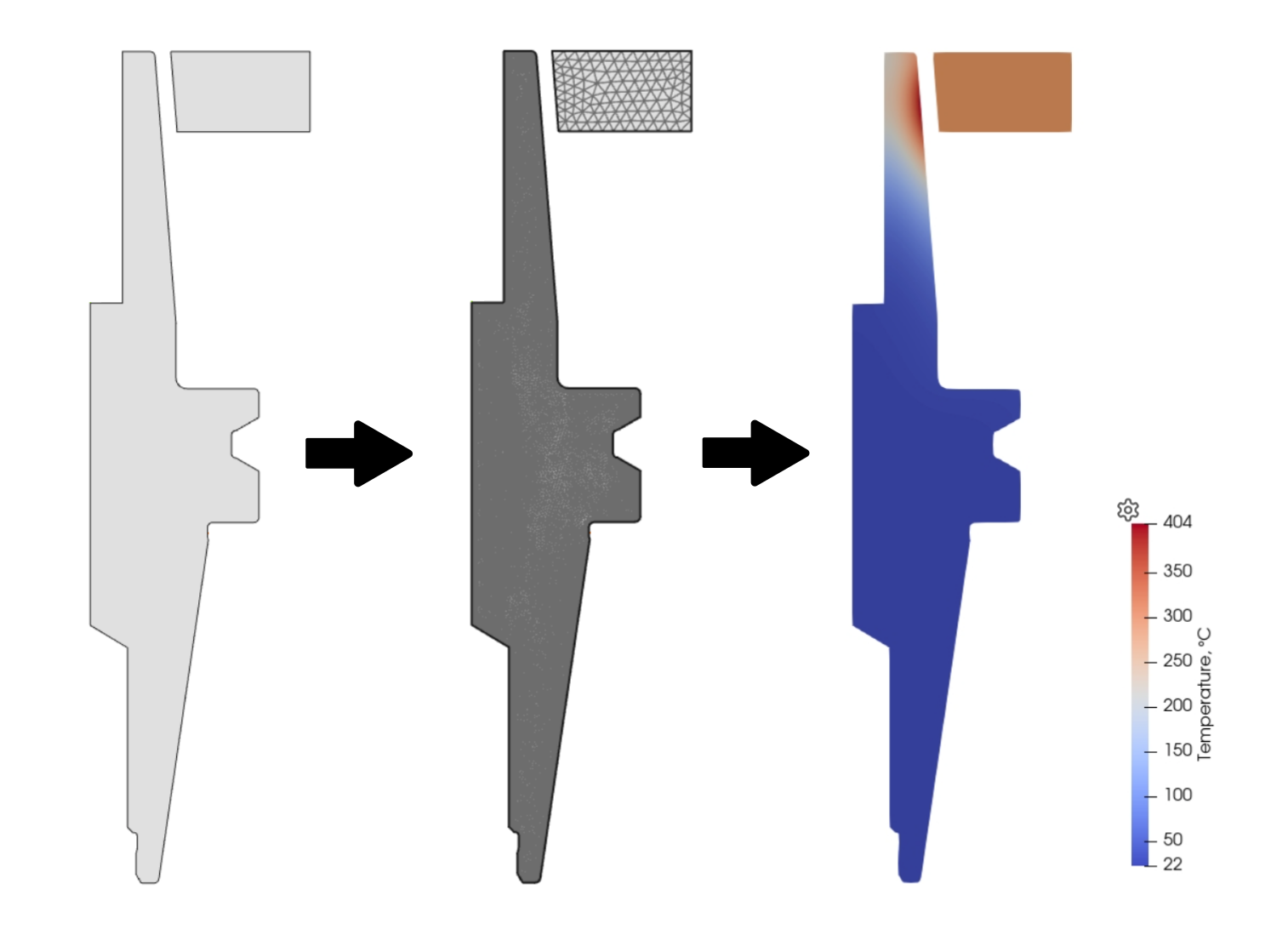
To demonstrate how fully coupled EM + Thermal + Mechanical simulation addresses this challenge, we analyze a standard H13 steel tool holder subjected to a high-frequency induction heating cycle followed by air and conduction cooling.
| Parameter | Value |
|---|---|
| Workpiece Material | AISI H13 Hot-Work Tool Steel |
| Inductor Current | A: 700 A
B: 1200 A |
| Operating Frequency | A: 20 kHz
B: 30 kHz |
| Heating Phase | 5 s |
| Cooling Phase | 795 s |
Because H13 steel exhibits temperature-dependent yield behavior, holding peak current for even a fraction of a second too long drastically lowers yield stress while driving up thermal expansion – the exact recipe for plastic strain accumulation. Because of this, thermal, electromagnetic and mechanical material properties are temperature dependent to accurately capture the heating process.
Result Analysis: Controlled Expansion vs. Excessive Heating
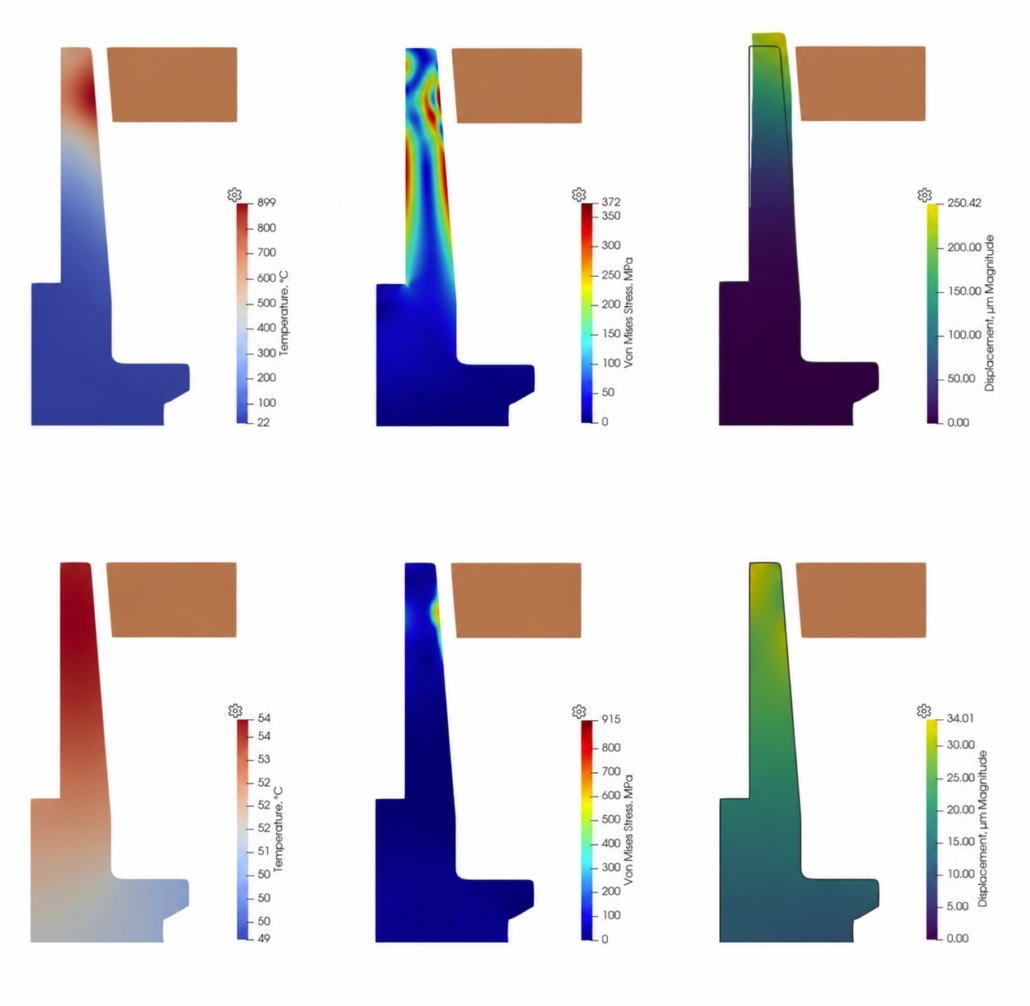
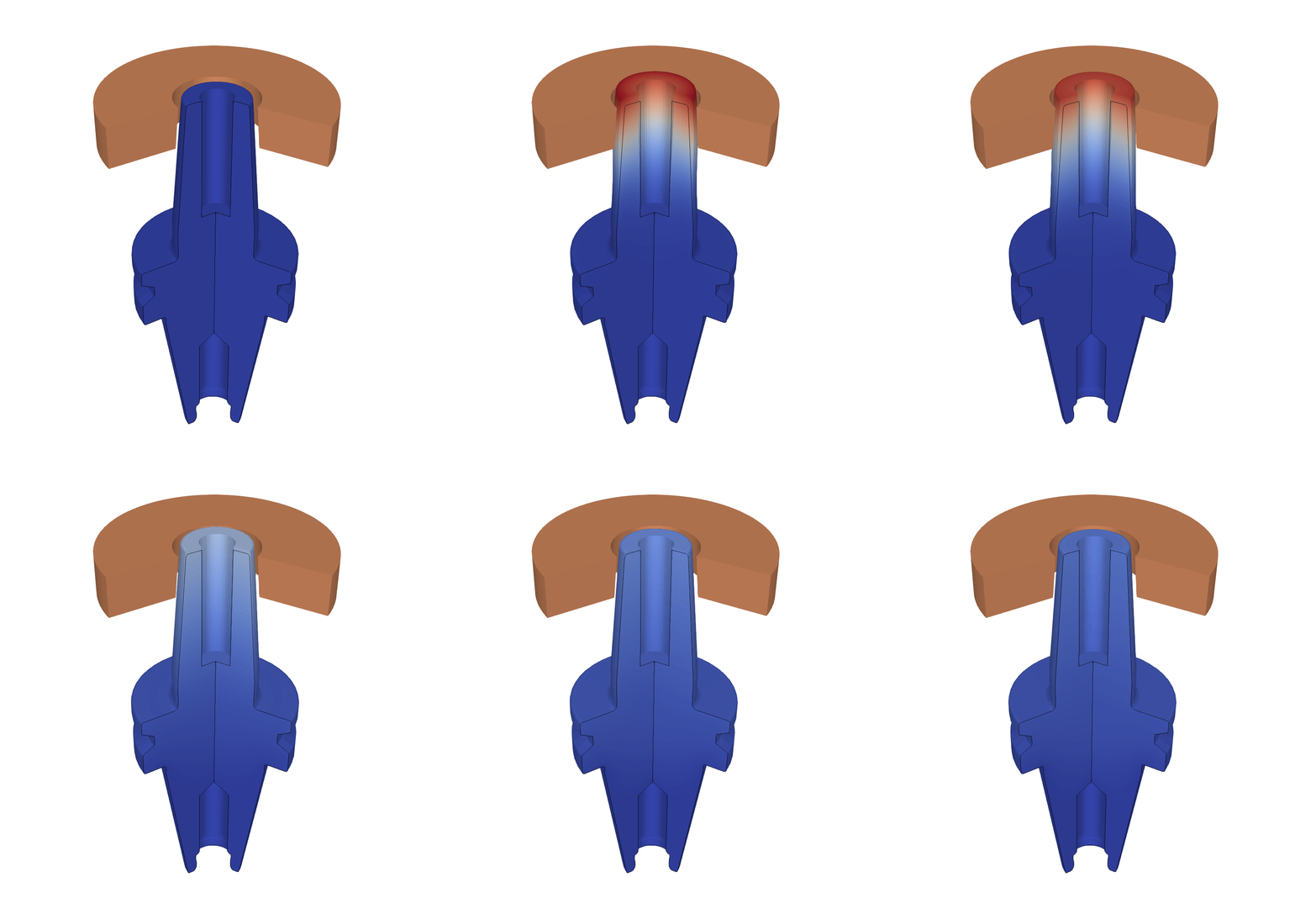
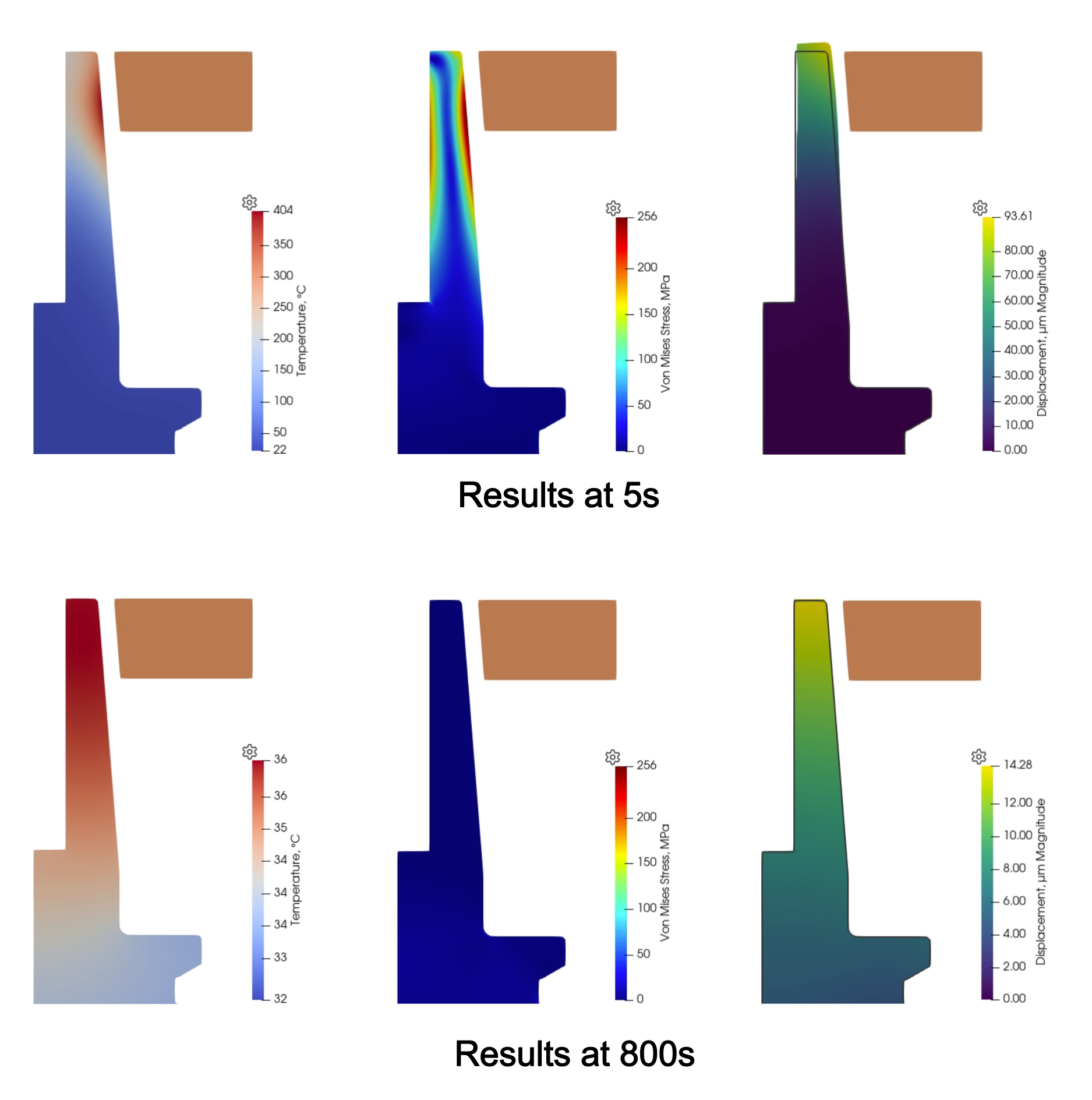
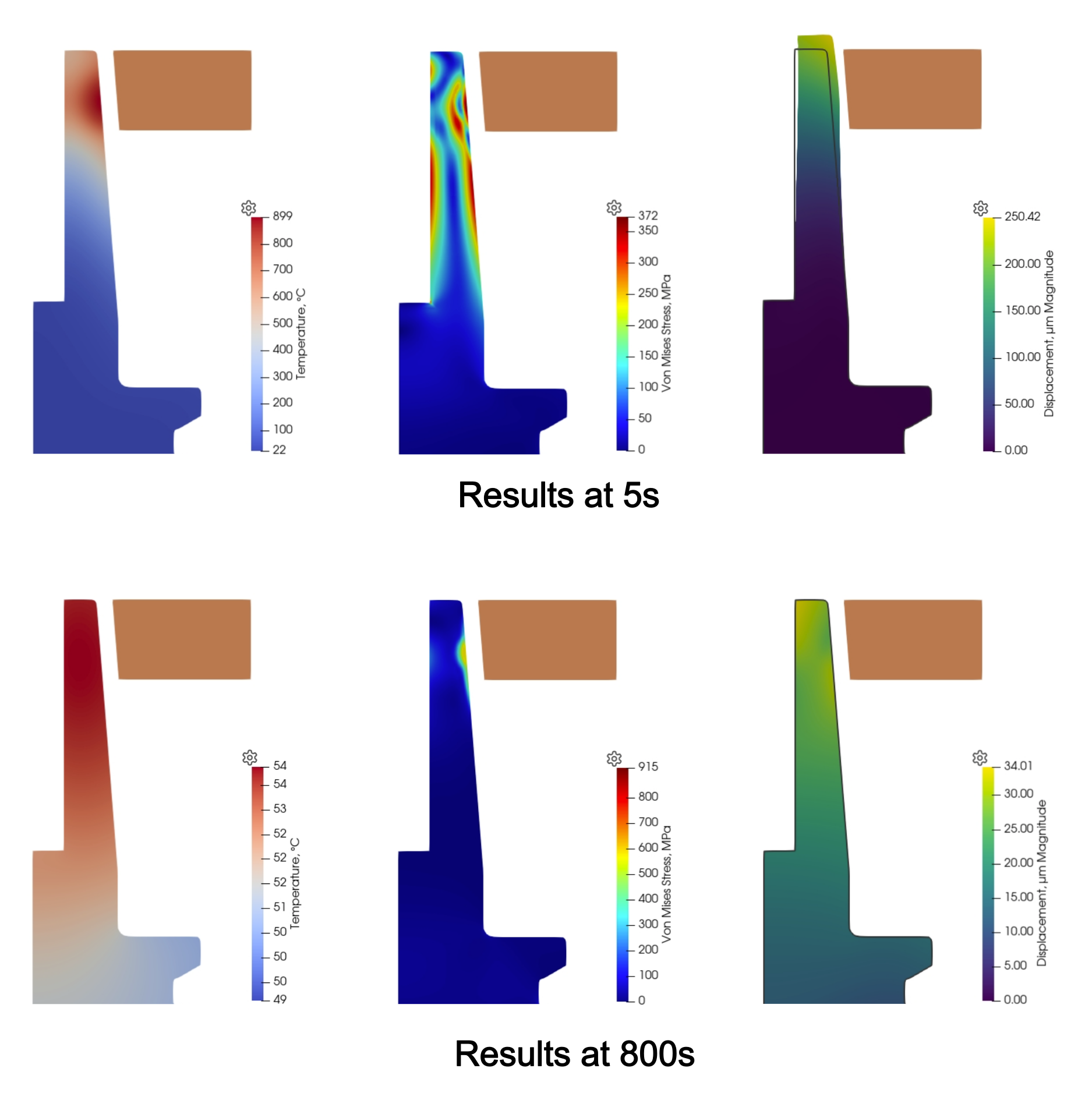
Using CENOS, we compare two operational regimes for the 5-second heating :
- REGIME A: Nominal Power Input (700 A, 20 kHz) ──► Controlled Temperature ──► σ_v < σ_y(T) ──► Elastic Strain ──► Zero Permanent Deformation
- REGIME B: Too High Power Input (1200 A, 30 kHz) ──► Overheating Outer Wall ──► σ_v ≥ σ_y(T) ──► Plastic Yielding (ε_p > 0) ──► Permanent Bore Distortion
Regime A: Controlled Elastic Process
- Thermal Profile: At t = 5 s, the bore wall reaches the target temperature of ~400 °C required to expand the internal diameter past the tool shank diameter.
- Stress State: High compressive hoop stresses form in the heated zone, but Von Mises stress remains below the material yield curve.
- Deformation: Bore wall expands 93.61 μm, enough for tool to be inserted inside.
- Post-Cooling (t = 800 s): As the temperature normalizes during the 795 s cooling window, all thermal strain resolves elastically. Permanent plastic strain remains zero (ε_p = 0). Bore dimensions return exactly to design specifications.
Regime B: Excessive Local Heating & Yield Point Exceedance
- Thermal Profile: Excessive current density causes surface temperatures to spike above critical thresholds at ~900 °C.
- Plastic Yielding: Because H13 yield strength degrades rapidly at elevated temperatures, thermal expansion forces the hot material into plastic deformation (ε_p > 0).
- Post-Cooling (t = 800 s): Upon full thermal relaxation (795 s cooling), the plastically deformed zones cannot return to their original coordinates. The tool holder exhibits residual stress concentration and permanent dimensional bore shrinkage or out-of-roundness, ruining the precision fit for future tool changes.
How CENOS helps eliminate mechanical defects in shrink fitting
The CENOS Mechanical Module provides a direct solution to these thermomechanical risks:
- Integrated Multi-Physics: Solve Electromagnetic, Thermal, and Mechanical structural equations in a single unified workflow without manually transferring data between different solvers.
- Predictive Yield Boundaries: Identify the exact time step and current intensity where elastic stress transitions into plastic strain.
- Optimized Cycle Times: Fine-tune inductor coil geometry, frequency, current and heating duration down to the millisecond to ensure required clearance while maintaining structural safety margins.
- Virtual Prototyping ROI: Avoid costly physical scrap and premature tool holder fatigue by validating thermal-mechanical performance entirely in software.
By integrating electromagnetic, thermal, and mechanical physics into a single simulation loop, engineers eliminate the costly guess-and-check cycle of physical prototyping. CENOS allows thermal and structural designers to accurately map temperature-dependent yield thresholds, pinpoint the precise power-to-time window required for sufficient bore expansion, and predict residual plastic stresses before a single part is heated. Ultimately, virtual testing protects expensive tooling investments, optimizes energy consumption during tool changes, and guarantees long-term assembly precision and joint integrity.