
Defining stranded inductors
Many different coils and inductors are used in induction heating process, one of them being stranded coil. Stranded coil refers to a coil consisting of many fine turns of conducting wires.
Electromagnetic analysis of a stranded coil can be complicated because the geometry of the coil is complex. CENOS gives you the advantage of defining a solid coil as stranded through a specific domain type, and ease the simulation of it to a minimum.
Difference Between Stranded Wire and Non-Stranded Wire
Stranded wire consists of multiple strands of insulated wire twisted or braided together and connected in parallel, typically at the ends of the coil. In contrast, non-Stranded wire is a single, continuous strand of wire.
When comparing the two with equivalent inputs:
- Non-Stranded Wire:
- Higher resistance.
- Higher voltage.
- This is due to the single strand carrying the entire current, increasing the resistive losses.
- Stranded Wire:
- Lower resistance.
- Lower voltage.
- This is because the current is distributed across multiple strands, reducing resistive losses due to their parallel connection.
When to use Stranded Coil domain?
The Stranded Coil Source domain type is suitable for both 2D and 3D simulations of stranded coils, especially when the number of strands is too high to efficiently resolve them through explicit geometry.
By using the Stranded Coil domain type, you can:
- Reduce mesh element count and shorten simulation time, and
- Simplify geometry creation by modeling the coil as a solid body and defining it as stranded, without needing to manually create individual strands.
Important: To simulate a stranded coil, replace the coil geometry with an equivalent cross-sectional shape, define it as a Stranded Coil Source, and proceed with the calculation!
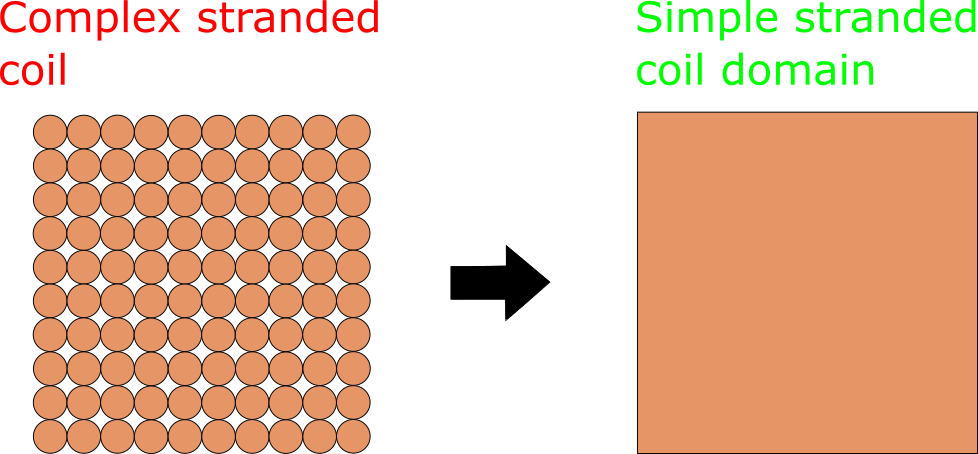
How to use Stranded Coil?
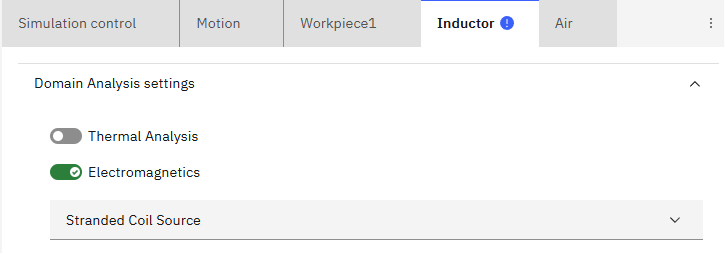
You can easily access Stranded Coil Source domain under Domain type dropdown menu.
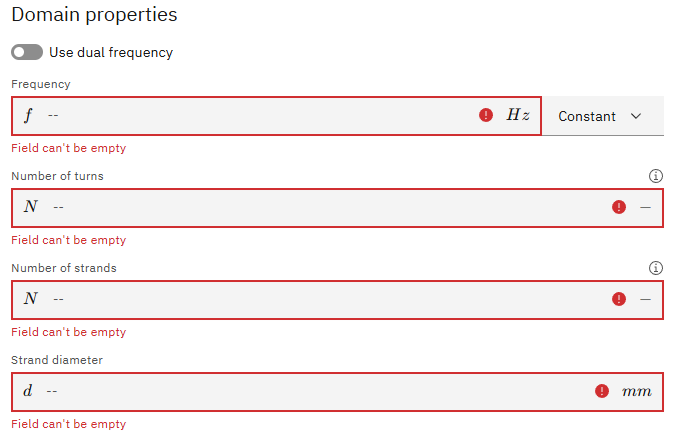
When the Stranded Coil Source is selected, the Domain Properties section will appear, containing four parameters:
- Frequency
- Number of Turns
- Number of strands
- Strand diameter
Here you need to pay attention to the difference between turns and strands:
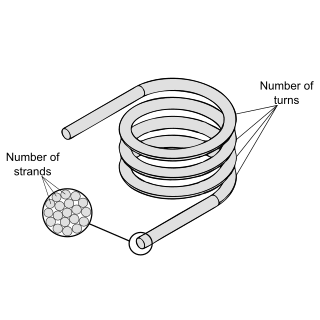
The turns are the big windings of the coil, whereas the strands are the small wires that make up the inductor.
For example, if you have a coil with multiple windings but it does not have any smaller strands inside, then you would define the number of strands as 1.
On the other hand, if your coil has strands inside the windings, you might define each turn as a separate inductor (and input number of turns as 1 for each of them), or approximate the whole coil and input the number of turns and strands accordingly.
Current
The defined current represents the current in a single strand, as it assumes a single long strand forming all the loops.
If transitioning from a solid inductor carrying 1000 A to a simple stranded coil with 10 strands and a total current of 1000 A, you need to enter 100 A in the Current (Amplitude) field. This ensures the same current density across the wire’s cross-sectional area.
Mesh
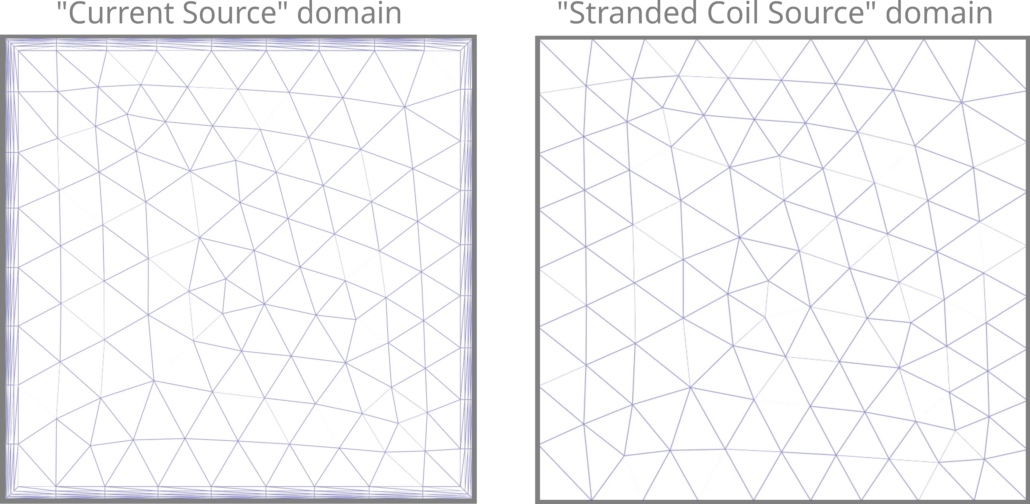
The Stranded Source domain simplifies the geometry and reduces the element count, making simulations more efficient. Unlike the Current Source domain, the Stranded Coil Source domain does not require resolving the skin layer, which can significantly save computational resources.
Important: Ensure that the mesh in the Stranded Coil Source domain is uniform for accurate results.
Limitations
Stranded coil source can be used only in the cases, where the skin layer of the strand (in the case of no strands – of a turn) is approximately equivalent to the diameter of the strand (or turn).
If the skin layer is significantly smaller than the diameter, the results will be incorrect.